

Understanding the advantages, risks, and best practices of biometric verification
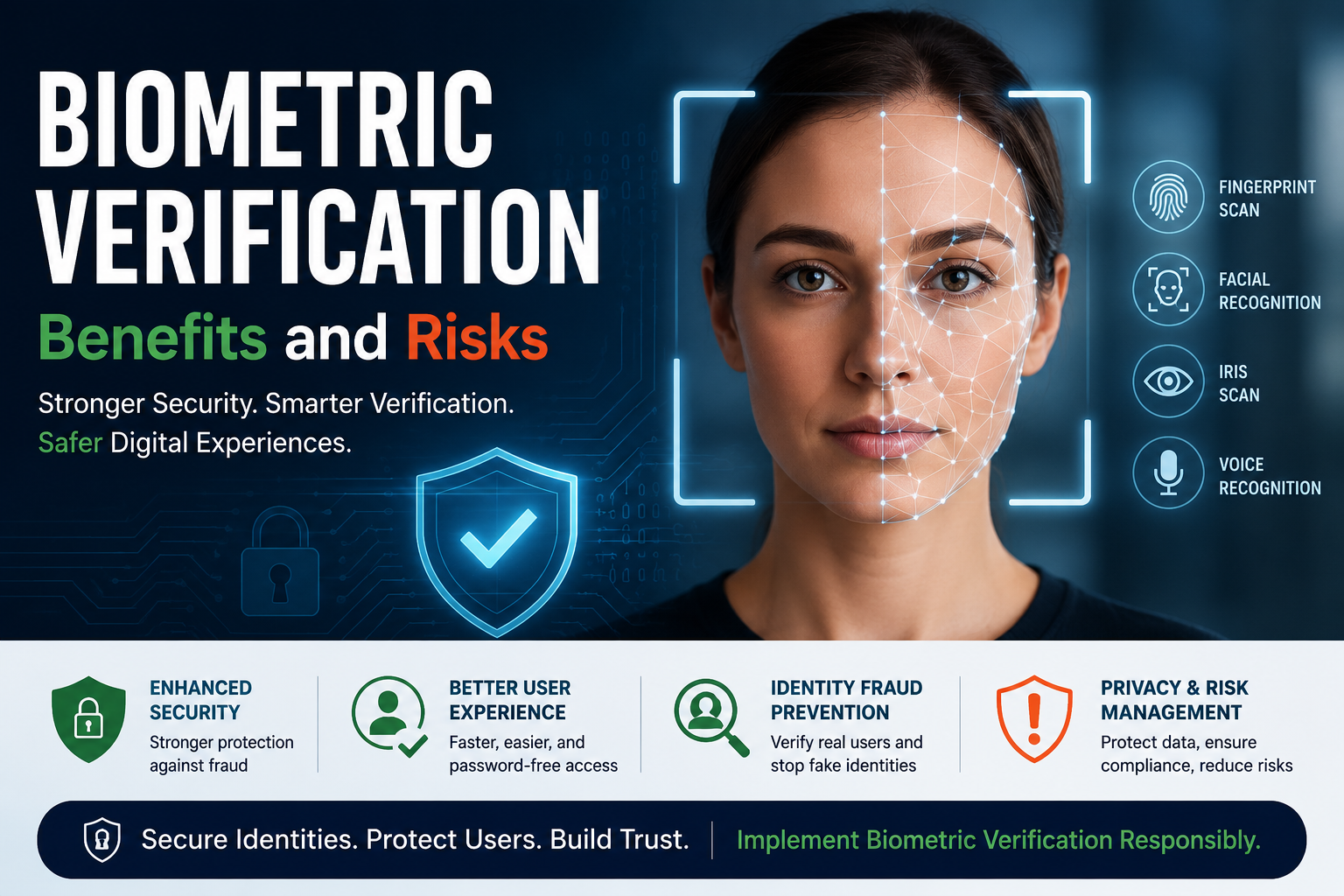
Digital identity verification has become one of the biggest challenges for businesses operating online. From SaaS companies and financial institutions to creator platforms and online marketplaces, organizations must ensure that users are who they claim to be without creating unnecessary friction during onboarding.
As cybercrime continues to evolve, traditional passwords and PINs are no longer enough to protect sensitive information. According to Verizon's 2024 Data Breach Investigations Report, stolen credentials remain one of the leading causes of data breaches, while identity fraud continues to cost businesses billions of dollars each year. These growing threats have accelerated the adoption of biometric verification as a more secure and reliable method of confirming user identity.
Today's smartphones, banking applications, and enterprise software increasingly rely on fingerprints, facial recognition, iris scans, or voice recognition to authenticate users. Industry reports estimate that the global biometric market will continue to grow rapidly over the coming years as organizations prioritize stronger digital security and seamless user experiences.
While biometric authentication offers significant advantages in preventing fraud and improving convenience, it also introduces important concerns around privacy, data protection, and regulatory compliance.
This article explores both the benefits and risks of biometric verification, helping SaaS companies, marketplaces, creator platforms, and other businesses understand how to implement biometric technology responsibly while strengthening identity fraud prevention.
For decades, passwords have been the primary method of securing online accounts. Unfortunately, they have also become one of the weakest links in cybersecurity. Weak passwords, password reuse, phishing attacks, and credential theft continue to expose businesses and users to significant security risks.
Biometric technology addresses many of these challenges by using unique physical or behavioral characteristics to verify an individual's identity. Unlike passwords that can be forgotten, guessed, or shared, biometric identifiers are directly linked to the user.
Common forms of biometric verification include fingerprint recognition, facial recognition, iris scanning, voice recognition, and, in some advanced systems, behavioral biometrics such as typing patterns or device interactions.
The increasing availability of biometric sensors in smartphones, tablets, and laptops has also contributed to widespread adoption. What once required expensive hardware is now available to millions of users through devices they already own, making biometric verification both practical and scalable.
For businesses, this means stronger authentication without significantly increasing complexity for customers.
One of the biggest reasons organizations invest in biometric authentication is its ability to improve security while simplifying the user experience.
Unlike traditional credentials, biometric characteristics are unique to each individual. Although no authentication method is entirely immune to attacks, duplicating a person's fingerprint or facial structure is considerably more difficult than stealing a password through phishing or malware.
This additional layer of identity assurance significantly reduces the likelihood of unauthorized account access.
Another major advantage is convenience.
Customers no longer need to remember dozens of complex passwords or repeatedly complete lengthy verification processes. A fingerprint scan or facial recognition check can verify identity within seconds, creating a faster and more seamless experience.
For SaaS businesses, reducing login friction often translates into higher user satisfaction and lower support costs associated with password resets.
Biometric verification also strengthens trust between businesses and customers.
When users know that strong identity verification measures are in place, they are generally more confident about sharing sensitive information, conducting financial transactions, or storing valuable data on a platform.
This trust is particularly valuable for marketplaces and creator platforms where financial transactions and digital identities play a central role.
Additionally, biometric systems improve accountability by linking actions to verified users rather than anonymous credentials. Organizations can better monitor account activity, detect suspicious behavior, and investigate security incidents when user identities have been verified with greater certainty.
Identity fraud continues to be one of the fastest-growing forms of cybercrime worldwide.
Fraudsters frequently exploit stolen credentials, fake identities, and synthetic identities to create fraudulent accounts, access financial services, or impersonate legitimate users.
By implementing identity fraud prevention measures that include biometric verification, businesses create additional barriers for attackers attempting to bypass traditional authentication systems.
Many modern onboarding processes now combine document verification with facial recognition to ensure that users presenting identity documents are physically present during verification.
This approach significantly reduces the success rate of fake identities, account takeovers, and automated bot registrations.
For online marketplaces, this helps create safer communities where buyers and sellers can interact with greater confidence.
Creator platforms also benefit by verifying genuine creators, reducing impersonation, protecting monetization systems, and increasing overall platform credibility.
Rather than relying solely on usernames, passwords, or email verification, biometric technology provides stronger assurance that every verified account belongs to a real individual.
Security solutions often introduce additional steps that frustrate users.
Biometric verification offers an effective balance between protection and convenience.
Instead of repeatedly entering passwords, receiving one-time codes, or answering security questions, users can authenticate themselves almost instantly using a biometric scan.
This reduces login abandonment while improving customer satisfaction.
Businesses also benefit operationally.
Password-related support requests represent a significant portion of IT helpdesk workloads. By reducing dependency on passwords, organizations can decrease support costs while allowing technical teams to focus on higher-value security initiatives.
For SaaS platforms serving thousands or even millions of users, these operational improvements can generate measurable savings over time.
Furthermore, biometric authentication integrates naturally with multi-factor authentication (MFA). Rather than replacing existing security measures, biometrics often strengthen them by combining "something you are" with "something you know" or "something you have."
This layered security approach provides stronger protection against increasingly sophisticated cyber threats.
Despite its many advantages, biometric authentication is not without challenges.
Unlike passwords, biometric characteristics cannot simply be changed if they are compromised.
If a password is exposed during a data breach, users can reset it immediately. However, fingerprints, facial features, and iris patterns remain permanent throughout a person's life.
This makes the secure collection, storage, and processing of biometric information critically important.
Privacy is another major concern.
Biometric data represents highly sensitive personal information. Organizations collecting this data must clearly explain why it is being collected, how it will be stored, who can access it, and how long it will be retained.
Customers increasingly expect transparency regarding the use of their personal information, especially as awareness of digital privacy continues to grow.
Without strong governance policies, businesses risk damaging customer trust even when their intentions are legitimate.
While biometric verification provides stronger identity assurance than traditional passwords, it is not immune to cyber threats. Like any technology, its effectiveness depends on how it is implemented and managed.
One of the primary concerns is biometric data security. If biometric templates are stored improperly or transmitted without adequate encryption, they become valuable targets for cybercriminals. Unlike passwords, biometric identifiers cannot simply be replaced if they are compromised, making secure storage and access controls essential.
Another challenge is biometric spoofing. Attackers have developed increasingly sophisticated methods to bypass biometric systems using fake fingerprints, high-resolution photographs, 3D facial masks, or recorded voice samples. Although modern biometric solutions incorporate liveness detection and artificial intelligence to identify fraudulent attempts, no system can guarantee complete protection.
False positives and false negatives also remain operational concerns. Environmental conditions, lighting, aging, injuries, or sensor quality can occasionally prevent legitimate users from authenticating successfully or, in rare cases, incorrectly identify unauthorized users. Businesses should therefore balance convenience with appropriate security thresholds based on their risk profile.
These challenges highlight an important reality: biometric verification should strengthen security—not become the only security measure.
Successfully implementing biometric authentication requires more than simply adding facial recognition or fingerprint scanning to an application. Businesses should adopt a layered security strategy that balances usability, privacy, and fraud prevention.
Instead of relying solely on biometrics, organizations should combine biometric verification with multi-factor authentication (MFA). Pairing "something you are" with "something you know" or "something you have" creates multiple layers of protection, making unauthorized access significantly more difficult.
Organizations should also invest in liveness detection technologies that verify users are physically present during authentication. These systems help prevent spoofing attempts using photographs, videos, or artificial masks.
Equally important is secure infrastructure. Biometric templates should always be encrypted, transmitted over secure communication channels, and protected using strict access controls. Regular software updates and vulnerability assessments ensure that biometric systems remain resilient against evolving cyber threats.
Finally, transparency plays a critical role. Businesses should explain their biometric verification process in clear, user-friendly language and provide customers with options to manage their privacy preferences whenever possible. Trust is strengthened when users understand how their data is protected.
The future of biometric verification extends far beyond unlocking smartphones.
Artificial intelligence and machine learning are making biometric systems more accurate by continuously improving facial recognition, behavioral biometrics, and fraud detection capabilities. Emerging technologies can now analyze typing behavior, mouse movements, touchscreen interactions, and device usage patterns to identify users without requiring additional actions.
Decentralized identity solutions are also changing how biometric information is managed. Rather than storing sensitive biometric data in centralized databases, newer identity models allow users to retain greater control over their personal information while securely sharing verification results when necessary.
As digital services continue expanding across finance, healthcare, e-commerce, creator platforms, and enterprise software, biometric verification will increasingly become part of everyday authentication. However, its success will depend on maintaining the right balance between security, privacy, and user experience.
Businesses that adopt responsible biometric practices today will be better positioned to meet future customer expectations and evolving regulatory requirements.
The rapid growth of digital services has made identity verification more important than ever. Passwords alone can no longer provide the level of protection needed against modern cyber threats, making biometric verification an increasingly valuable solution for businesses seeking stronger security and improved user experiences.
By leveraging biometric authentication, organizations can reduce unauthorized access, strengthen identity fraud prevention, simplify user onboarding, and build greater trust with customers. At the same time, they must recognize that biometric technology introduces unique responsibilities related to privacy, data protection, and regulatory compliance.
The most effective approach is not to view biometrics as a standalone security solution but as part of a broader identity verification strategy. Combining biometric authentication with multi-factor authentication, secure encryption, liveness detection, continuous monitoring, and transparent privacy practices creates a more resilient defense against evolving cyber threats.
For SaaS companies, online marketplaces, creator platforms, and businesses handling sensitive customer information, responsible biometric verification is no longer just an emerging technology—it is becoming a competitive advantage. Organizations that invest in secure, privacy-first implementation today will be better equipped to protect users, prevent fraud, and build lasting confidence in their digital platforms.