

As U.S. laws expand, platforms now rely on secure user authentication, digital identity verification, and OTP solutions for platforms to improve safety and compliance
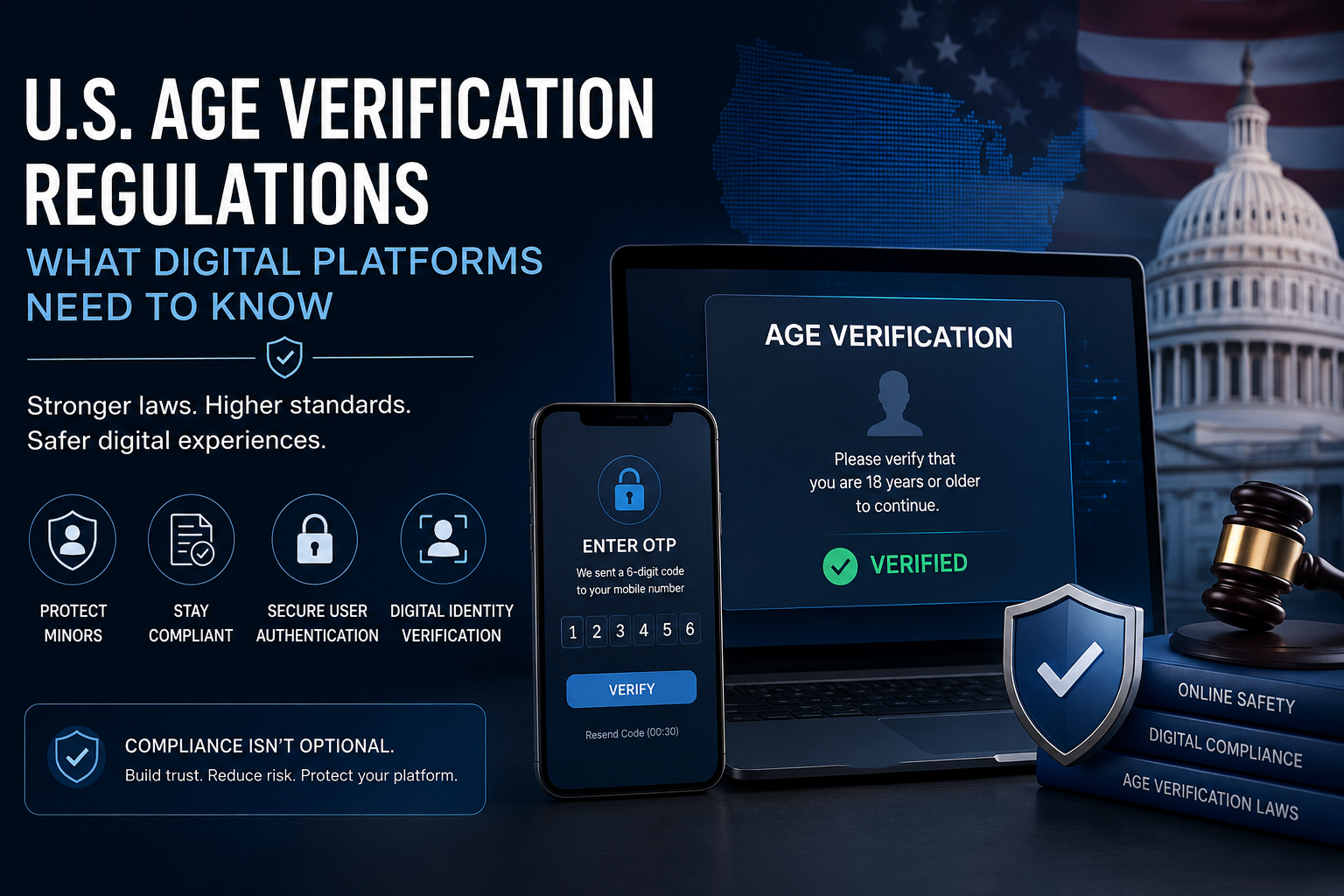
The digital platform economy has changed dramatically over the last decade. Adult content websites, gaming platforms, creator subscription services, and social communities now serve millions of users daily across the United States. At the same time, lawmakers and regulators are placing increasing pressure on platforms to improve user safety, prevent underage access, and strengthen online accountability.
For many businesses, age verification is no longer viewed as a simple sign-up step. It has become a core compliance requirement tied directly to platform trust, legal exposure, and brand reputation.
In 2025 alone, multiple U.S. states introduced or expanded laws requiring online platforms to verify user age before granting access to certain forms of content or digital services. These regulations are especially important for industries where minors may be exposed to adult material, gambling-style mechanics, livestream monetization, or subscription-based creator content.
As enforcement increases, platforms are now expected to adopt stronger systems for secure user authentication, digital identity verification, and fraud-resistant onboarding processes.
The push for stronger online age verification comes from growing concerns around child safety, harmful online exposure, and digital exploitation.
According to data from the National Center for Missing and Exploited Children, reports involving online child exploitation have increased significantly over the past several years. At the same time, lawmakers have raised concerns about underage users accessing adult platforms, anonymous creator services, and gaming environments with financial transactions or explicit content.
Several major technology companies have also faced lawsuits and public criticism over weak verification systems that relied solely on self-declared age entry. Regulators increasingly argue that asking users to “confirm they are over 18” is no longer sufficient.
This shift has created a new standard for platform responsibility.
Today, the legal question is not simply whether a platform intentionally targets minors. Regulators now examine whether minors are reasonably likely to access the service. That distinction has major consequences for gaming communities, creator subscription platforms, and adult content businesses.
For digital platforms, age verification has become part of a larger conversation around platform accountability and user protection.
Unlike Europe, the United States does not currently operate under one unified federal age verification framework. Instead, platforms face a growing mix of state-level legislation and federal regulatory pressure.
States such as Texas, Louisiana, Utah, Arkansas, and Virginia have introduced laws requiring online services to implement stricter age checks for adult or sensitive content access. Some laws also place additional obligations on social media and digital platforms likely to attract underage users.
In Louisiana, age verification requirements for adult websites gained national attention after enforcement began under Act 440. Similar legislation quickly spread to other states.
Meanwhile, lawmakers continue proposing broader digital safety regulations focused on minors, including stricter parental consent requirements, transparency obligations, and platform accountability measures.
Although some laws remain under legal review, the direction is clear. Online platforms are expected to demonstrate proactive efforts to prevent underage access.
For businesses operating nationally, this creates a serious operational challenge. A platform may comply with regulations in one state while facing stricter obligations in another.
As a result, many companies are now implementing scalable digital identity verification systems that can adapt across jurisdictions rather than relying on inconsistent regional processes.
For years, many platforms relied on basic age gates that asked users to enter their birth date before continuing.
Those systems are now widely considered ineffective.
Studies have repeatedly shown that underage users can bypass simple age prompts within seconds. Regulators increasingly view these methods as symbolic compliance rather than meaningful protection.
Modern compliance expectations now focus on verification methods that provide stronger assurance while balancing privacy and usability.
This has led to increased adoption of technologies such as government-issued identity checks, facial age estimation systems, mobile-based verification, and layered authentication frameworks.
The goal is not necessarily to collect excessive personal information. Instead, regulators want platforms to demonstrate that they have implemented reasonable and proportionate measures to reduce underage access risks.
For many businesses, this means creating layered onboarding systems that combine identity signals, fraud detection, and account verification processes.
One of the biggest challenges facing digital platforms is balancing security with user experience.
Aggressive verification processes can increase friction and reduce conversions. Weak verification systems, however, expose businesses to compliance risks and reputational damage.
This is where secure user authentication plays an important role.
Modern authentication systems help platforms confirm that users are legitimate, reachable, and less likely to be fraudulent or underage. Authentication tools can also reduce fake account creation, account sharing, and bot-driven abuse.
Phone-based authentication has become particularly valuable because mobile numbers often provide an additional trust layer connected to real-world user activity.
For example, platforms increasingly use OTP solutions for platforms during account registration and login verification. One-time passcodes sent through SMS or authentication apps help verify that users control a valid mobile number before gaining account access.
This process improves both security and accountability.
According to cybersecurity industry reports, multi-factor authentication can prevent the majority of automated account takeover attempts. While OTP systems alone may not fully verify age, they contribute to a stronger compliance framework when combined with other verification layers.
For subscription-based platforms handling payments or creator monetization, secure authentication also helps reduce fraud-related financial losses.
As regulations evolve, digital identity verification is quickly moving from an optional feature to a business necessity.
Identity verification technologies allow platforms to assess whether users are likely genuine while identifying suspicious or high-risk activity patterns.
These systems may include ID document validation, mobile network verification, facial recognition checks, behavioral fraud analysis, and device intelligence monitoring.
For adult platforms and creator subscription services, identity verification is particularly important because platforms may face liability if minors gain access to restricted content.
Gaming platforms are also under increasing scrutiny, especially where online purchases, loot-box mechanics, or livestream interactions are involved.
At the same time, users are becoming more privacy-conscious. Research from Pew Research Center shows that many consumers worry about how companies store and use personal information online.
That means platforms must implement verification systems carefully. Excessive data collection can damage trust just as much as weak security practices.
The most effective verification systems are therefore designed around minimal friction, privacy protection, and transparent user communication.
Ignoring age verification requirements is becoming increasingly risky for digital platforms.
Potential consequences include regulatory penalties, lawsuits, payment processor restrictions, app store removal risks, and long-term brand reputation damage.
Even platforms that are not directly targeted by regulators may face pressure from payment providers, advertisers, or business partners demanding stronger compliance standards.
This is especially relevant for adult platforms and creator monetization businesses that depend heavily on payment infrastructure and user trust.
Reputation damage can also spread quickly online. A single incident involving underage access may trigger media attention, social backlash, and long-term brand harm.
For growing platforms, proactive compliance is now often viewed as a competitive advantage rather than simply a legal obligation.
The future of digital platforms will increasingly depend on trust.
Users want safer online experiences. Regulators want stronger protections for minors. Business partners want lower compliance risk.
Age verification alone cannot solve every safety challenge, but it plays a major role in building more responsible digital ecosystems.
Platforms that invest in secure user authentication, modern verification technologies, and scalable OTP solutions for platforms are better positioned to meet evolving legal expectations while protecting their users and brand reputation.
Most importantly, effective verification systems help create environments where legitimate users feel safer interacting, subscribing, and conducting transactions online.
U.S. age verification regulations are evolving rapidly, and digital platforms can no longer afford to treat compliance as an afterthought.
Adult content services, gaming communities, creator subscription businesses, and other online platforms are entering a new era of accountability where user safety and verification standards are under close scrutiny.
The challenge for businesses is finding the right balance between compliance, privacy, and user experience.
Platforms that adopt stronger digital identity verification processes and implement reliable OTP solutions for platforms will be far better prepared for the future regulatory landscape.
As online safety expectations continue to rise, trust will become one of the most valuable assets any digital platform can build.