

Balancing security, privacy, and trust in modern biometric verification
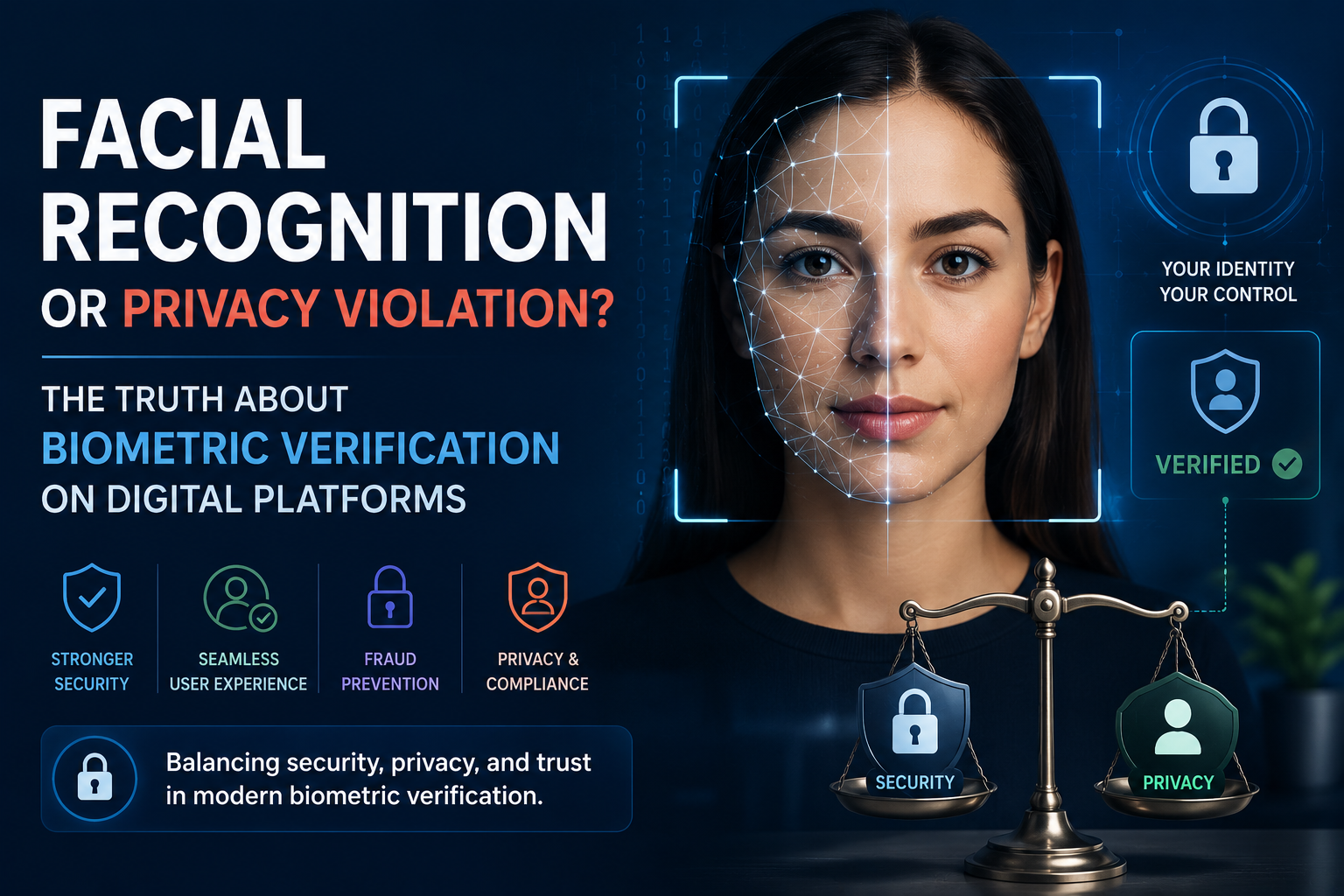
As digital platforms continue to expand, verifying user identity has become more important than ever. From SaaS applications and online marketplaces to creator platforms and financial services, businesses are under growing pressure to protect user accounts while delivering fast and seamless onboarding experiences.
Traditional authentication methods such as passwords and one-time passcodes are no longer sufficient to combat today's sophisticated cyber threats. According to the Verizon 2024 Data Breach Investigations Report, stolen credentials remain one of the leading causes of data breaches worldwide. At the same time, identity fraud continues to increase as cybercriminals use stolen documents, phishing attacks, synthetic identities, and account takeover techniques to bypass conventional security measures.
These challenges have accelerated the adoption of biometric verification, particularly facial recognition, as a modern approach to confirming user identities. Smartphones, banking applications, payment platforms, and enterprise software increasingly rely on biometric technologies to provide stronger security without compromising convenience.
However, the growing use of facial recognition has also sparked an important debate. While businesses view it as an effective tool for fraud prevention and user authentication, privacy advocates continue to raise concerns about data protection, surveillance, and regulatory compliance.
So, does facial recognition represent the future of secure digital identity, or does it introduce new privacy risks that businesses cannot afford to ignore?
This article explores both sides of the discussion, helping organizations understand how biometric authentication can improve security while respecting user privacy and meeting modern compliance requirements.
Digital businesses process millions of user registrations every day. Each new account presents an opportunity for growth—but it can also become an entry point for fraud if identity verification is weak.
Attackers have become increasingly sophisticated in exploiting stolen credentials, fake identity documents, automated bots, and synthetic identities to gain unauthorized access to digital services.
Passwords alone are no longer capable of providing adequate protection. Users frequently reuse passwords across multiple websites, making compromised credentials valuable targets for cybercriminals. Multi-factor authentication has improved security, but businesses continue searching for authentication methods that are both stronger and easier for users.
This is where biometric verification has gained significant attention.
Instead of relying on information users know, such as passwords or security questions, biometric systems verify identity using unique physical characteristics that are significantly more difficult to replicate.
Facial recognition has emerged as one of the most widely adopted biometric technologies because nearly every modern smartphone and laptop already includes a high-quality camera capable of supporting identity verification.
For businesses, this enables stronger authentication without requiring customers to purchase additional hardware.
Facial recognition is a form of biometric authentication that identifies or verifies an individual by analyzing unique facial characteristics.
Rather than storing a simple photograph, modern biometric systems convert facial features into encrypted mathematical templates. During authentication, these templates are compared with a newly captured image or live video to determine whether the individual matches the verified identity.
Many advanced platforms also incorporate liveness detection to confirm that the person being verified is physically present. This technology helps prevent attackers from using printed photographs, recorded videos, or digital images to bypass identity checks.
Artificial intelligence has further improved the accuracy of facial recognition by enabling systems to recognize faces under different lighting conditions, camera angles, and facial expressions.
As these technologies continue to evolve, facial recognition has become an increasingly practical solution for secure digital onboarding and account protection.
The primary objective of biometric verification is to ensure that every verified account belongs to a genuine individual.
Unlike passwords that can be stolen or shared, facial characteristics are unique to each user. This makes unauthorized access considerably more difficult, especially when facial recognition is combined with document verification and liveness detection.
For businesses operating online marketplaces or creator platforms, verifying real users helps reduce fake profiles, impersonation, account takeovers, and fraudulent transactions.
Financial institutions have also embraced biometric authentication to strengthen Know Your Customer (KYC) processes while reducing onboarding fraud.
Another important advantage is speed.
Traditional manual verification often requires compliance teams to review uploaded identity documents individually, delaying customer onboarding. Automated facial recognition systems can complete the same verification process within seconds while maintaining high levels of accuracy.
The result is improved security without sacrificing customer convenience.
Beyond fraud prevention, biometric authentication delivers measurable business advantages.
One of the most significant benefits is improved customer experience. Long registration forms and repeated authentication requests often cause users to abandon onboarding before completing the process. Facial recognition simplifies identity verification by allowing users to verify themselves quickly using devices they already own.
Operational efficiency also improves.
Automated verification reduces manual document reviews, lowers administrative costs, and allows compliance teams to focus on high-risk cases instead of processing every customer individually.
Businesses can also strengthen customer trust by demonstrating a commitment to secure identity management.
Users are increasingly willing to share personal information when they understand that organizations are investing in advanced security technologies designed to protect their accounts from unauthorized access.
For SaaS platforms handling sensitive business information, stronger authentication also reduces the likelihood of account compromise, protecting both customers and the organization's reputation.
Despite its advantages, facial recognition remains one of the most debated biometric technologies.
Unlike passwords, biometric characteristics cannot simply be changed if compromised. This makes facial data significantly more sensitive than traditional login credentials.
Privacy advocates have also raised concerns about how biometric information is collected, processed, stored, and shared. Customers often worry that facial images could be retained indefinitely, used for purposes beyond identity verification, or accessed without their knowledge.
These concerns have become even more significant as governments introduce stricter privacy regulations governing biometric information.
For businesses, adopting facial recognition responsibly requires more than implementing advanced technology. It also requires transparency, accountability, and strong data governance practices that protect customer privacy throughout the verification process.
As the adoption of biometric verification grows, governments and regulatory bodies are introducing stricter rules to ensure that biometric data is collected and processed responsibly.
Privacy regulations such as the General Data Protection Regulation (GDPR) in Europe, the California Consumer Privacy Act (CCPA), and the Illinois Biometric Information Privacy Act (BIPA) classify biometric information as sensitive personal data. Businesses using facial recognition must therefore comply with strict requirements regarding user consent, data protection, retention policies, and transparency.
Organizations should clearly explain why biometric information is being collected, how it will be used, and how long it will be retained. Users should have confidence that their biometric data will only be processed for legitimate verification purposes and not shared or reused without their knowledge.
Many businesses are also adopting privacy-first verification models that avoid permanently storing facial images. Instead, encrypted biometric templates or verification results are retained only for as long as necessary, significantly reducing privacy risks while still meeting compliance obligations.
Responsible data management not only supports regulatory compliance but also strengthens customer confidence in digital platforms.
While facial recognition has become increasingly accurate, it is not without limitations.
One concern is the possibility of spoofing attacks. Cybercriminals continue to experiment with high-resolution photographs, recorded videos, and sophisticated deepfake technology to impersonate legitimate users. Although modern biometric systems include liveness detection and artificial intelligence to identify these attacks, businesses should recognize that no security solution is completely immune to evolving threats.
Accuracy can also be influenced by environmental conditions. Poor lighting, camera quality, facial coverings, or significant changes in appearance may occasionally prevent successful authentication. These situations can create frustration for legitimate users if appropriate fallback verification methods are not available.
Another important consideration is algorithmic fairness. Earlier generations of facial recognition technology demonstrated varying levels of accuracy across different demographic groups, raising concerns about bias and equal treatment. Continuous improvements in artificial intelligence and broader training datasets have significantly enhanced system performance, but businesses should still evaluate their technology providers carefully and regularly monitor verification outcomes.
Recognizing these challenges helps organizations implement facial recognition more responsibly while maintaining confidence in their verification processes.
Businesses should approach biometric authentication as one component of a broader identity security strategy rather than relying on it as a standalone solution.
Combining facial recognition with document verification, liveness detection, multi-factor authentication, and risk-based monitoring creates multiple layers of protection against identity fraud.
Choosing a trusted verification provider is equally important. Organizations should evaluate technology partners based on security certifications, encryption standards, compliance capabilities, fraud detection accuracy, and ongoing platform updates.
Transparency should remain central to every implementation. Clear privacy notices, simple consent processes, and easily accessible data protection policies help users understand how their biometric information is handled. When customers know that their privacy is respected, they are more likely to complete verification with confidence.
Businesses should also conduct regular security assessments, penetration testing, and compliance reviews to ensure their verification systems remain effective against emerging threats.
Finally, organizations should continuously monitor authentication performance by reviewing fraud detection rates, onboarding completion times, false rejection rates, and customer feedback. Ongoing optimization ensures that security improvements never come at the expense of user experience.
The role of facial recognition is expected to expand as digital identity technologies continue to evolve.
Artificial intelligence is making biometric systems more accurate by improving facial matching, reducing false positives, and strengthening fraud detection. At the same time, behavioral biometrics, decentralized identity frameworks, and verifiable digital credentials are creating new opportunities to verify users while giving them greater control over their personal information.
Many organizations are also moving toward privacy-enhancing technologies that process biometric information securely without retaining unnecessary personal data. This shift reflects growing customer expectations for both convenience and privacy.
As cyber threats become increasingly sophisticated, businesses will need authentication methods that can adapt quickly while maintaining compliance with evolving regulations. Facial recognition, when implemented responsibly, is likely to remain an important part of this future.
Success will not depend solely on adopting advanced technology, but on using it in a way that balances security, transparency, fairness, and respect for user privacy.
The debate surrounding facial recognition is not simply about choosing between security and privacy. Both are essential for building trustworthy digital platforms.
When implemented responsibly, biometric verification provides businesses with a powerful way to strengthen identity assurance, reduce fraud, accelerate onboarding, and improve the overall user experience. At the same time, organizations must recognize that biometric information requires higher standards of protection than traditional authentication methods.
Responsible implementation begins with transparency, informed user consent, strong encryption, limited data retention, regulatory compliance, and continuous security monitoring. Businesses that treat biometric privacy as a core part of their identity strategy are better positioned to earn customer trust while reducing operational and compliance risks.
For SaaS companies, online marketplaces, creator platforms, and organizations implementing biometric authentication, facial recognition should not be viewed as a replacement for good security practices. Instead, it should be integrated into a layered identity verification framework that combines advanced technology with responsible data governance.
Ultimately, facial recognition is neither inherently a privacy violation nor a complete security solution. Its impact depends on how thoughtfully it is implemented. Organizations that balance innovation with privacy will be best equipped to deliver secure, compliant, and trusted digital experiences in an increasingly connected world.