

KYC and age verification can involve similar checks, but they answer different questions. Here is how platforms can decide what they actually need to verify.
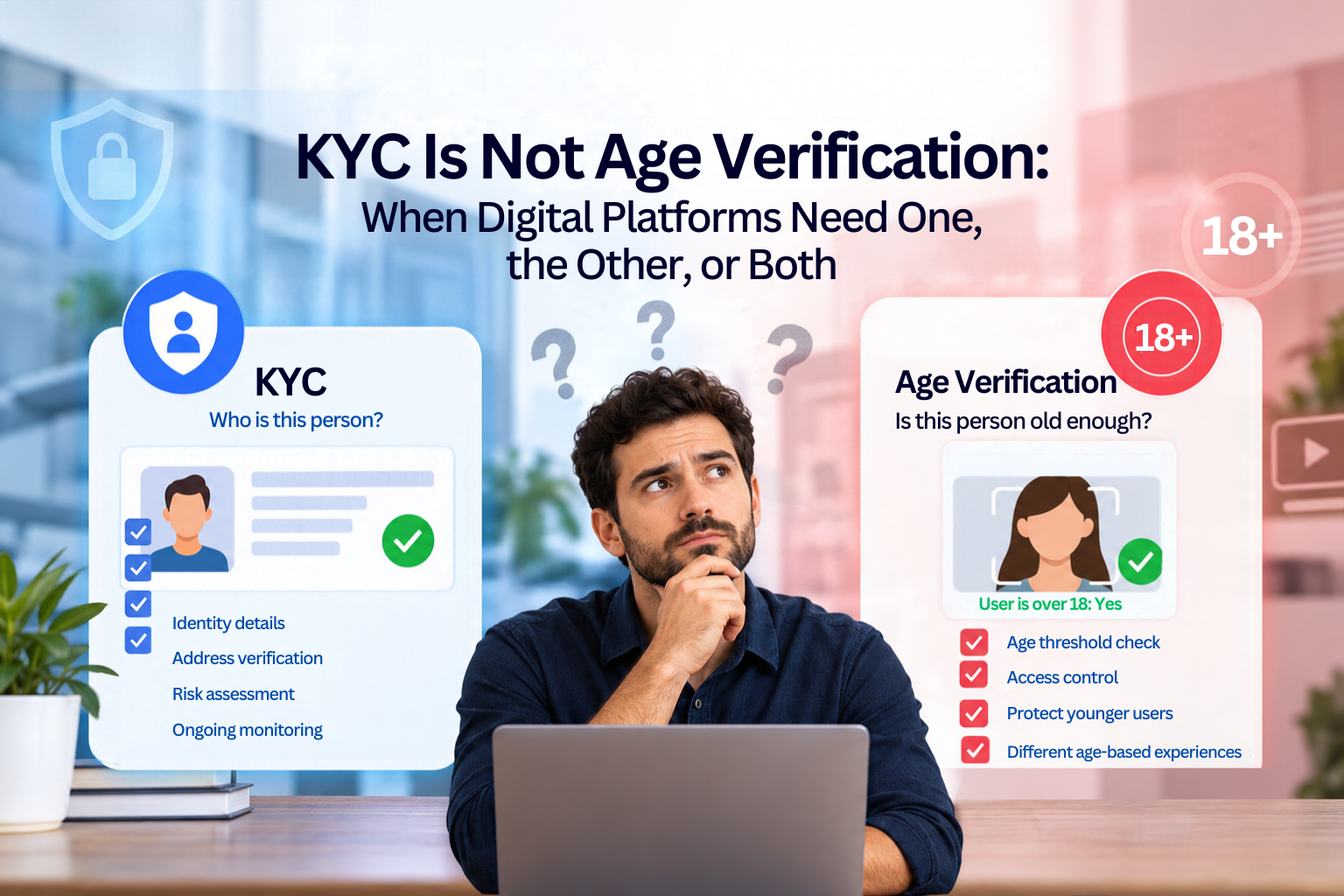
A user uploads an identity document. Their name is confirmed, their date of birth is visible, and the verification succeeds.
Has the platform completed KYC? Has it verified the user’s age? Or has it simply verified an identity?
Those questions sound similar — they are not the same.
This distinction matters because digital platforms increasingly need to decide who can create an account, access particular content, sell services, receive payments, or use age-restricted features. Treating every verification process as “KYC” can lead to unnecessary checks. Treating an age check as full identity verification creates the opposite problem.
The better starting point is simple: what does the platform actually need to establish about this person?
KYC, or Know Your Customer, is closely tied to customer due diligence. It is designed to establish who a customer is and, where the relevant regulatory framework applies, support an assessment of the risks associated with that customer or business relationship.
Under typical customer due diligence requirements, identifying and verifying a customer can involve full name, date of birth and residential address. Depending on the circumstances, due diligence may also require understanding the purpose and intended nature of the relationship, identifying beneficial owners, and applying additional measures where risk is higher.
That is why choosing a KYC verification platform should not be reduced to one question: “Can it check an ID?” The platform first needs to understand which checks are actually required for its activity and why.
Not every website, marketplace, creator platform or SaaS business automatically has a legal obligation to conduct KYC simply because it has users. Formal customer due diligence obligations depend on the activity being performed, the applicable regulatory framework, and the nature of the business relationship.
Age assurance is concerned with establishing or estimating a user’s age, or determining whether they meet a particular age threshold. Age verification is one approach within that broader process.
A service may need to determine only whether a user is an adult before allowing access to particular content or functionality. In that case, the information required may be as narrow as: “Is this person 18 or over?”
That does not necessarily mean the service needs to know the person’s full identity.
Current age-assurance guidance recognises several approaches capable of determining whether a user is an adult or a child. These can include digital identity services, facial age estimation, photo-ID matching, credit-card checks, mobile-network age checks and open banking. Simply asking someone to enter a date of birth is not considered sufficient for situations requiring highly effective age assurance.
This is an important distinction for product teams. Age assurance is an outcome, not necessarily a request for a passport.
Imagine a platform receives a reliable result from an age-assurance process:
“User is over 18: Yes.”
That result may establish what the platform needs for an age-gated feature. By itself, it does not necessarily tell the platform the user’s verified legal name, residential address or other identity information.
Data-protection principles encourage organisations using age assurance to consider proportionality and data minimisation. A platform should think carefully about whether it needs a person’s full identity when its actual objective is simply to establish an age threshold.
A well-designed user verification platform therefore needs to be considered in the context of the question the business is trying to answer. Verification should not become a reason to collect additional personal information without a defined purpose.
The reverse misunderstanding is equally common.
Suppose a SaaS platform confirms that an identity document is genuine and that the person presenting it matches the document. The platform may now have strong evidence about that person’s identity.
That does not automatically mean it has completed every element of customer due diligence that may apply in a regulated relationship.
KYC can extend beyond identity proofing. Depending on the applicable requirements and risk, customer due diligence can include understanding the purpose of a relationship, identifying beneficial ownership, and carrying out ongoing monitoring or enhanced checks.
Identity verification can therefore be part of KYC without being synonymous with KYC.
This distinction is particularly useful when considering identity verification for SaaS platforms. A software service may have a legitimate reason to verify certain users for account integrity, fraud prevention, access control or another defined business purpose without that check automatically becoming regulatory KYC.
Start with the service itself.
Does access to particular content, functionality or interaction depend on whether the user has reached a certain age? Is the service subject to rules requiring an effective method of distinguishing adults from children? Does the platform need different experiences or protections for different age groups?
If the central question is whether the user meets an age threshold, age assurance is the relevant concept.
The required method still depends on context. A low-risk service and a service exposing users to age-restricted content do not necessarily require the same level of certainty.
For services subject to online-safety duties concerning certain harmful or pornographic content, highly effective age assurance must correctly determine whether a user is an adult or a child. Regulatory guidance assesses approaches against factors including technical accuracy, robustness, reliability and fairness.
That is substantially different from placing an “I am over 18” checkbox on a registration page.
The first question should be whether the business or activity falls within a regulatory framework that requires customer due diligence.
Where those obligations apply, customer identification and verification form part of a broader process. The required checks can vary according to the customer, transaction, business relationship and level of risk.
Digital verification can play a role. Regulated businesses may, subject to the relevant requirements, use qualifying digital verification services for identity checks within customer due diligence. Using such a service does not replace the wider due diligence obligations that may apply.
A platform should avoid starting with the assumption that every user must undergo KYC. A marketplace seller, a subscriber reading content, and a customer entering a regulated financial relationship may present very different verification questions.
Sometimes the two requirements meet.
Consider a platform that provides age-restricted functionality while also carrying out a regulated activity for which customer due diligence applies. The same user journey may therefore involve an age-assurance requirement and a separate KYC or customer due diligence requirement.
The platform may need to answer two separate questions:
Information gathered during one process may sometimes contribute to the other. A verified identity document containing a date of birth is an obvious example. But overlapping evidence does not make the purposes identical.
This distinction matters when designing the verification journey. Instead of asking every user for the maximum possible amount of information, a platform can identify what needs to be established at each point and choose a proportionate method.
Before choosing technology or adding another step to registration, product and compliance teams can ask four practical questions:
Answering those questions before selecting the verification method can prevent a common design mistake: building the most intrusive process first and deciding what it is for afterwards.
KYC, identity verification and age verification can sit next to each other in the same onboarding journey. They can even rely on some of the same evidence. But that does not make them interchangeable.
A platform may need one of these processes, several of them, or different checks for different groups of users.
The sensible place to start is not “How much can we verify?”
It is “What do we need to know, why do we need to know it, and what is the proportionate way to establish it?”